
TAO is trading roughly where it began the year. Bittensor, however, is a very different network.
At a recent offsite, we spent time taking an honest look at Bittensor's progress over the past year. We came away convinced that the network has quietly had a remarkable year, both within the subnet ecosystem and at the protocol level.
The clearest evidence is the revenue of the subnet ecosystem. At the end of 2025, the ecosystem was generating roughly $20M in annualized revenue. Today, that figure is closer to $54M, a 2.5x increase in less than a year (number comes from our internal dashboard; we're working on releasing a public version very soon).
What's particularly impressive is that revenue more than doubled despite TAO's flat price providing no boost to miner incentives. At the same time, the network's first halving last December cut TAO incentives in half. In other words, subnets generated substantially more revenue despite having fewer economic incentives to produce it.
Tracked team buybacks now offset 4.7% of TAO emissions. With subnet and miner registration fees, along with transaction fees, total demand offsets reached 10.9% of emissions.
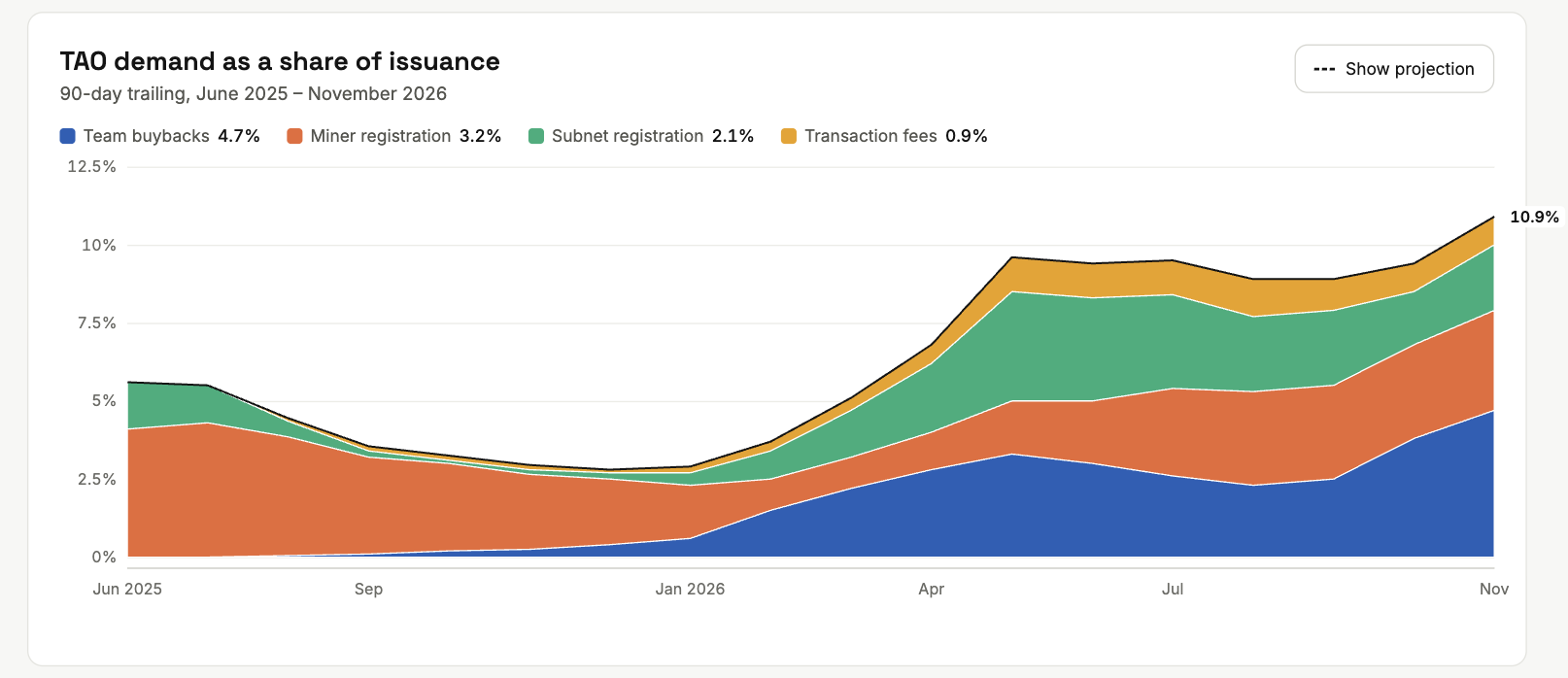
We believe this is one of Bittensor's most important metrics. The ultimate goal is for economic activity across the network to generate enough demand for TAO to offset new issuance. The trajectory so far is incredibly encouraging.
Much of the token buyback activity is being driven by infrastructure subnets providing access to GPUs, inference, storage, and other foundational services. As these products have become more competitive over the past year, subnets are increasingly becoming customers of one another, while also attracting customers from outside Bittensor. Signs of a network state forming before our eyes.
Our view is that 2026 will be remembered as the year of infrastructure, while 2027 will be the year of intelligence.
By intelligence, we mean subnets producing genuinely useful AI models and agents, powered by the infrastructure built over the past year. We're already seeing early signs of this transition with subnets like Affine, Iota, Ingot, Reliquary, and Teutonic producing pareto optimal models.
Meanwhile, the protocol itself has undergone an important transformation. The mechanism that determines how TAO emissions are distributed across subnets, arguably the most important function of Bittensor, was overhauled. The return to price-weighted emissions, alongside concentrating the majority of rewards among the top 32 subnets, has made the allocation system considerably more capital efficient.
Protocol investments were another major development. Rather than only using TAO emissions for liquidity into subnet pools, the protocol now uses emissions to purchase subnet tokens. This has created a built-in protocol investment arm that directs capital toward subnets, giving founders another source of financing and making the network a more attractive place to build.
Since protocol investments began in June, the network has purchased subnet tokens using approximately 384,000 TAO, worth $90.2 million at the time of purchase.
The Cost of Progress
The most common criticism I hear about Bittensor is that the protocol changes too frequently. And frankly, I agree. It's difficult to build a business on a platform where the rules are constantly changing. Founders need some degree of certainty around the environment they operate in.
But I also believe this period of rapid change has been necessary. No one has attempted what Bittensor is doing before. Getting the economic incentives right requires a lot of trial and error. The network needs room to experiment, learn, and adapt rather than prematurely ossifying around a suboptimal design.
What we find to be remarkable is that despite all this volatility, existing founders have stuck around and new ones continue to show up. Four new subnets launched in the past week alone. That says a lot about how compelling Bittensor already is as a platform for builders.
Two major upgrades remain on the near-term roadmap: Gamma and shorting. I expect these to be the last big swings of this era. Once they ship, the core team’s focus shifts to decentralization, and the pace of development slows into something builders can plan around.
If that plays out, Bittensor will enter 2027 with a more stable protocol, a mature infrastructure ecosystem, and a new generation of subnets beginning to produce valuable intelligence.
After years of experimentation, Bittensor is getting closer to exiting "beta" and opening its doors to a much broader wave of founders.
This commentary is provided by Unsupervised Capital Management LLC for informational and educational purposes only. It does not constitute an offer to sell, a solicitation of an offer to buy, or a recommendation of any security, investment product, or investment strategy. Nothing herein constitutes investment, legal, tax, or other advice, nor should it be relied upon in making any investment decision.
This material contains forward-looking statements that are based on current expectations and assumptions and are subject to risks and uncertainties. Actual results may differ materially. References to specific digital assets, protocols, or projects are not endorsements and should not be construed as recommendations to buy or sell.
Digital assets involve substantial risk, including the potential for complete loss of principal. Past performance is not indicative of future results.
