
We’re One of the Largest TAO Holders and Want Builders on Bittensor to Raise Equity
One of crypto's oldest arguments is whether tokens and equity can coexist.
The prevailing view says no, which we also believe to be true for most tokens. But that's only because most tokens aren't designed for it, not because it can't be done.
The typical token-equity story starts with a company issuing a token, building a product that finds traction, then raising equity off that initial success. At that point, tokenholders realize they don’t have ownership in the business, don’t have a claim on its future cash flows, and have little protection if the company decides to prioritize shareholders. We saw a version of this play out recently when Venice AI raised a $65M equity round.
Tokens like these may still have value, but that value entirely depends on the team choosing to keep it relevant. Sometimes they do this through buybacks, routing fees to the token, or other acts of corporate goodwill. Other times the token buys access to a product, which only holds as long as the company keeps offering it on terms it controls. Either way, it all rests on the company's discretion.
And that's exactly the problem: token value rests entirely on discretion. Most tokens have no structural reason for why value has to flow back. If the token disappeared tomorrow, the business would run exactly as before. Which tells you everything you need to know. The token was never critical to the operation.
Even when there’s no equity at all, just a token and foundation, the problem still exists. Grass generated $17M in revenue in the first half 2026, and after sharing the figure on a network call, the token sold off sharply, with holders pointing to the lack of clarity on how any of that value would reach them. Which goes back to the core issue. Value back to the token still depends on whatever the foundation decides to send, whenever it decides to send it, with no rights binding them to it.
Value Must Flow to Token by Necessity
For a token to have value, it needs to be designed so that value flows through by necessity.
This exists today in Bittensor, and a handful of other proof-of-useful-work networks. Within Bittensor, subnets use token incentives to coordinate a network of miners around a specific objective, paying them for the work they provide.
Because miners are paid in the token, the token’s price determines the dollar value of the network’s incentive budget. A higher price gives the subnet more economic firepower to attract and retain the contributors it depends on. And because emissions are finite, any sustained increase in the amount the network needs to pay those contributors ultimately requires a more valuable token.
When a company builds on a subnet, that turns the token price into a lever on its production capacity. If the business needs more compute, more data, or more specialized work from the network, the incentive budget has to expand with it. That is what creates the mechanical connection between business growth and token value.
That connection is what an investor underwrites. If they believe the business will need more from the subnet as it grows, they can buy the token ahead of that demand. The bet is that business growth creates greater demand on the network, and greater demand on the network requires a more valuable token.
Bittensor Subnets
Each Bittensor subnet produces something useful. It can be some type of intelligence work or a commodity. But the commonality in every subnet is that the subnet’s token price acts as an incentive dial.
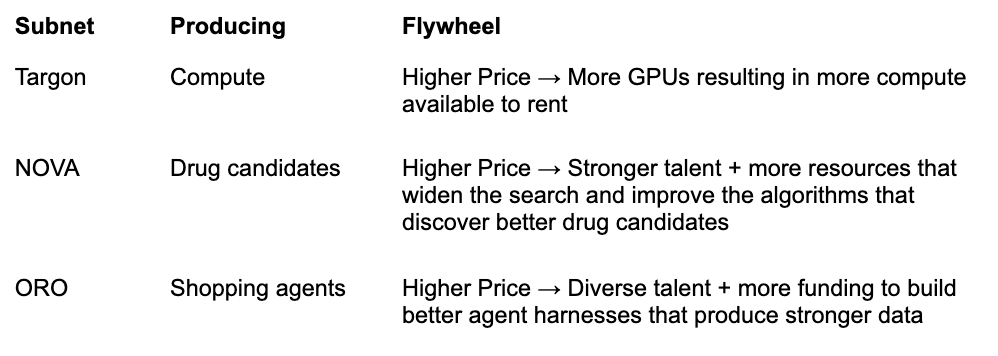
In each case, the token controls what the subnet produces and how much of it. Let the price fall and the output degrades. Raise the price and the output gets better. Take the token away entirely and no miner shows up the next day.
Of those three subnets, Targon is run by Manifold Labs, which has raised venture equity. Targon’s token works exactly the same way as the ones with no equity-backed company behind them at all.
Manifold depends on the subnet to source compute for its core business, renting compute via targon.com. Maintaining the price maintains the compute they can sell, and pushing the price higher brings more compute online. Manifold is actively using its own profits to buy the token and do exactly that. Not as a favor to holders, but because growing the core business requires it.
Reliance
Back to the original thesis. What makes a token valuable is that value flows through it by necessity. For that to happen, the subnet has to become a critical vendor the company is economically reliant on.
One path is cost advantage. A subnet should be the cheapest place to source the output because a permissionless supply side with no rent-extracting middleman should, in theory, push the price of a commodity toward its marginal cost. In a business where compute is the largest input cost, Targon’s ability to source the cheapest GPUs becomes the core of its competitive advantage.
The other path is non-substitutability. The output is too specialized to produce efficiently in-house or buy from a traditional vendor. ORO is the clearest example. Building the best shopping AI depends on collecting traces from as many different agents as possible, and the subnet gives them a deep contributor pool producing exactly that variety. The diversity of those traces is what makes the dataset valuable, and it would be extremely difficult to replicate through hiring alone or a specific vendor.
In both cases, the company's growth pulls the token up with it. As it needs more from the subnet, the USD price has to scale to get it.
Setting Expectations Straight
So tokenholders shouldn't expect to own the economics of whatever the company builds with the outputs. The company can own its equity value. The subnet token can own its production value. These were never the same thing, and they were never in conflict.
None of this stops a subnet team from doing more. They can share revenue with the network, add utility, whatever they think helps. But here those things are additive. They sit on top of a token that already holds value from being the input the work is paid in.
Go Ahead and Raise the Equity
We think that if a token is designed correctly, a company with equity behind it should be better for the token, not worse.
Equity capital lets the company scale the demand side. And the more they need from the subnet, the more they need the work to be good, which means keeping the incentive high enough to get it.
So to Bittensor’s subnet founders, raise your equity. Token holders stand to benefit alongside you.
This commentary is provided by Unsupervised Capital Management LLC for informational and educational purposes only. It does not constitute an offer to sell, a solicitation of an offer to buy, or a recommendation of any security, investment product, or investment strategy. Nothing herein constitutes investment, legal, tax, or other advice, nor should it be relied upon in making any investment decision.
This material contains forward-looking statements that are based on current expectations and assumptions and are subject to risks and uncertainties. Actual results may differ materially. References to specific digital assets, protocols, or projects are not endorsements and should not be construed as recommendations to buy or sell.
Digital assets involve substantial risk, including the potential for complete loss of principal. Past performance is not indicative of future results.
